
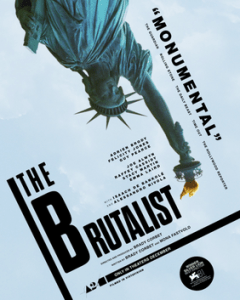
Close enough; welcome back, the 1970s studio picture!
“The Brutalist” is a historical epic that follows a European Holocaust survivor (Adrien Brody) who immigrates to America, and takes up work as an architect for a rich businessman (Guy Pearce). Felicity Jones, Joe Alwyn, Raffey Cassidy, Stacy Martin, Emma Laird, Isaach de Bankolé, and Alessandro Nivola also star, while Brady Corbet directs and co-writes with his partner, Mona Fastvold.
As the world’s collective attention span seems to be shrinking thanks to social media and 10-second Tik Tok videos, it seems Hollywood has gone in the opposite direction and is making their projects longer. Sometimes it’s entirely pointless (why is the live-action “Little Mermaid,” a film made for children, 135 minutes long?) but it has also given us a return of the large-scale adult drama (“Killers of the Flower Moon” runs for over 200 minutes and Best Picture winner “Oppenheimer” clocks in at three hours). “The Brutalist” is 215 minutes long and includes a 15-minute intermission, and while there are arguments to be made that it doesn’t need to be that length, there is no denying its epic scope and technical achievement.
Adrien Brody has had an interesting career, winning Best Actor in one of the biggest upsets in the Academy’s history back in 2002 but then going through phases where his only works are little-known projects and Wes Anderson cameos. There is no denying his talent, however, and his László Tóth, a Hungarian-born Jewish architect, mirrors that of Władysław Szpilman, his Oscar-winning role. Brody is sympathetic and clearly distressed, but at the same time humble and grateful to be in a post-war America. He gets some of the tortured artist tropes you would expect, but it never approaches cliché or exploitive.
Guy Pearce does a good job as Tóth’s benefactor Harrison Lee Van Buren. Pearce has always been able to play slimy and untrustworthy well (look at “Prometheus,” or “Iron Man 3,” or), and he puts those talents to work here. Van Buren puts out a charming public image but in conversations will let a more sinister demeanor slip through, and you know you shouldn’t trust him yet feel unable to accept him as a villain. The rest of the cast is solid, though no one is doing any heavy lifting or stretching too far out of their comfort zone (Felicity Jones is the loyal wife, Joe Alwyn is the pompous ignorant son, etc).
The cinematography by Lol Crawley is something to behold. Shot using VistaVision, a format made popular in the 1950s by “White Christmas” and Hitchcock’s “Vertigo” and retired in 1997 until now, the film has an authentic grainy feel to it that engrosses you into the mid-century setting. There are also plenty of insanely impressive long-takes, including the opening sequence that follows Brody as he wakes up in the hull of a sardine-packed ship and makes his way up to the deck to see the Statue of Liberty. Paired with Daniel Blumberg’s booming orchestra score, the moment sets the stage for the sheer scope and immersion to come. There were multiple points throughout the film where I found myself thinking of “The Godfather Part II” and “Once Upon a Time in America” due to the subject matter and lighting styles, but it always felt more like an homage than a copy/paste.
The way the film is constructed is interesting. Broken up in the middle by a 15-minute intermission (complete with a title card, countdown clock, and music), the first half of the film was far more interesting to me than the second, but I found myself blinking and the final hour simply racing by. I’m not sure that this needed to be 215 minutes but you certainly feel like you went on an odyssey with these characters, and just like “The Irishman” the film mirrors real-life in that you don’t process in the moment that the people around you are aging and changing. It isn’t until we look back over the years (or in this case, the hours) that you realize the hairs that have greyed and the relationships that have soured.
I can’t get into specifics about what I had issue with with the film’s narrative choices (specifically in act three), but I did find some plot points a bit aimless and one in particular that should have either been left ambiguous or made a bigger deal of at the time if they were going to use it as the driving force of our climax.
“The Brutalist” is, in many ways, a kind of American film that rarely gets made anymore, and certainly never on a $8 million budget by a director without the name power of Ridley Scott or Martin Scorsese. There is so much to digest, unpack, and discuss (I’m at over 750 words here and there are things I didn’t even touch on, like the detailed costumes or gritty production design), and I actually have no idea how the average moviegoer will receive this. It feels like the kind film that is destined to show up in an article in 15 years titled “the American Masterpiece We Don’t Talk About Enough” and it will either win six Oscars or go 0-10; but if you ask Scorsese, who has accomplished that feat thrice, it’s not necessarily a bad thing for your film’s legacy.
Critics Rating: 8/10
 The Reel Deal
One thought on “‘The Brutalist’ Review: A Sprawling Epic About the American Dream”