
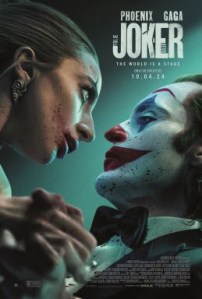
Shocker that the follow-up to a “eh, it’s fine” movie is… eh, fine.
“Joker: Folie à Deux” (French for “Madness for Two”) is the sequel to the 2019 film “Joker,” and features Joaquin Phoenix reprising his role as the titular Clown Prince of Crime. In the film, Joker, now institutionalized and awaiting trial, falls in love with a fellow inmate (Lady Gaga). Zazie Beetz also reprises her role, while Brendan Gleeson, Catherine Keener, and Steve Coogan join the cast; Todd Phillips returns to co-write and direct.
The first film was a surprise hit, becoming the first R-rated film to gross $1 billion on its way to 11 Oscar nominations (winning Best Actor and Best Original Score); I thought it was fine. Like many people I found fault with Phillips *clears throat* borrowing from Martin Scorsese films like “Taxi Driver” and “The King of Comedy,” but there are some things that work. The sequel (which no one really asked for and even Phillips and Phoenix originally said they had no intentions of making) tries to branch out and be something different, which is commendable, but it becomes clear early on that there was simply not enough content to justify a second film.
Joaquin Phoenix is a talented actor, but I thought his Best Actor win (like most of “Joker’s” awards) was a little silly, especially considering he beat the likes of Adam Driver in “Marriage Story.” I find most of the acting choices he made with the character obvious, and was never totally compelled with his Arthur Fleck. Here Phoenix is again solid, he has a few moments of awkward comedy or sympathetic pain, but once more they’re often the kinds of reactions you would expect from an actor like him in a role like this (similar flaw I had with Nic Cage in this year’s “Longlegs”). Joining the cast as Joker’s love interest Harley Quinn is Lady Gaga, who also is effective but again, it’s exactly the performance you’d expect from her in this role. She also feels very underutilized, because despite sharing many scenes with Phoenix her character feels like an underdeveloped afterthought.
The character I liked best was Brendan Gleeson’s prison guard, he has a good energy about him (friendly but at the same time threatening), and I thought Leigh Gill (reprising his role as one of Arthur’s old co-workers) was really good in his lone scene.
The film reportedly cost an inexplicit $200 million, an increase from the first film’s $60 million. And while that number is insane for a grounded drama (for comparison, “Dune: Part Two” cost $185 million and last year’s Best VFX winner “Godzilla Minus One” cost $15 million), the film’s production and 1980s details are impressive. From the damp basements of Arkham Asylum to the weed-filled courtyards, you can see the dollar on-screen, and being shot entirely with IMAX cameras adds a sense of grandiose. There is also a long one-take sequence that is quite impressive, though it comes a little late in the runtime to save the day.
So now the elephant in the room: the film is (partially) a musical. And I do commend Phillips and his team for trying something different with the comic book genre, and not simply doing what so many sequels do and just copy/paste of the first film. However. The musical sequences here are often jarring or not very catchy, usually taking place in a dream sequence that has no effect on the plot or add anything to the (already thin) characterizations. The film spends very little time with the titular Joker, and once we finally do get the charismatic (if not a little goofy) character instead of the mopey Arthur, it’s too late.
There are also at least two fairly important events that happen in the film that receive no resolution, one of which could have been used to have a satisfying confrontation. But that’s what you get when your film is written by the guy who made “Hangover Part III” and “Starsky & Hutch.”
“Joker: Folie à Deux” earns some points for trying to be different and for some immersive production design, but it is often meandering and takes a very, very long time to get going anywhere. It hints at commentary about the industrial prison complex, justice system, and abusive relationships, but like the first film Todd Phillips is not a skilled-enough writer/director to take on these themes. I’m sure just like the first film this will find an audience that sees it as a revolutionary entry into the genre while being divisive to everyone else, but the lingering sense of “why are we here?” was often too much to overcome for me. But that’s life.
Critics Rating: 5/10

 The Reel Deal
One thought on “‘Joker: Folie à Deux’ Review: A Meandering Sequel That Doesn’t Justify Its Existence”