

It’s crazy the dumb hot guy from “The Hangover” has become a nine (soon to be as much as 13)-time Oscar nominee.
“Maestro” is the second directorial effort from Bradley Cooper, who also stars as the titular conductor Leonard Bernstein. Carey Mulligan plays his wife Felicia Montealegre and Matt Bomer, Maya Hawke, and Sarah Silverman appear in supporting roles. Cooper also produces alongside Martin Scorsese and Steven Spielberg.
I enjoyed Cooper’s directorial debut “A Star Is Born,” and think he was robbed of both a Best Director nomination and a win for Best Actor (he played a troubled musician like winner Rami Malek, but actually learned how to sing and play instruments opposed to lip-synching, and gave a more layered performance). The life of Leonard Bernstein isn’t atop the list of people I’d desire seeing a biopic about, but thanks to solid work from Cooper and Mulligan, as well as some nice cinematography from Matthew Libatique, “Maestro” (mostly) overcomes a familiar screenplay.
Bradley Cooper is quietly one of the more accomplished actors of his generation, earning acting Oscar nominations for a half-dozen films and producing a handful of Best Picture nominees. Here, as the flamboyant Leonard Bernstein, Cooper portrays a man who know he can control a room with his charm, but never fully feels comfortable in his own skin. He also has several moments of simple physical comedy and reactions, little nuanced bits that elevate the performance. Mulligan, as Bernstein’s hard-nosed but loving wife, is equally effective, trying her best to play happy wife but is suppressing stress and annoyance at living in both her more-successful husband’s shadow, and the double life of a wife of a closeted gay man in the 1960s.
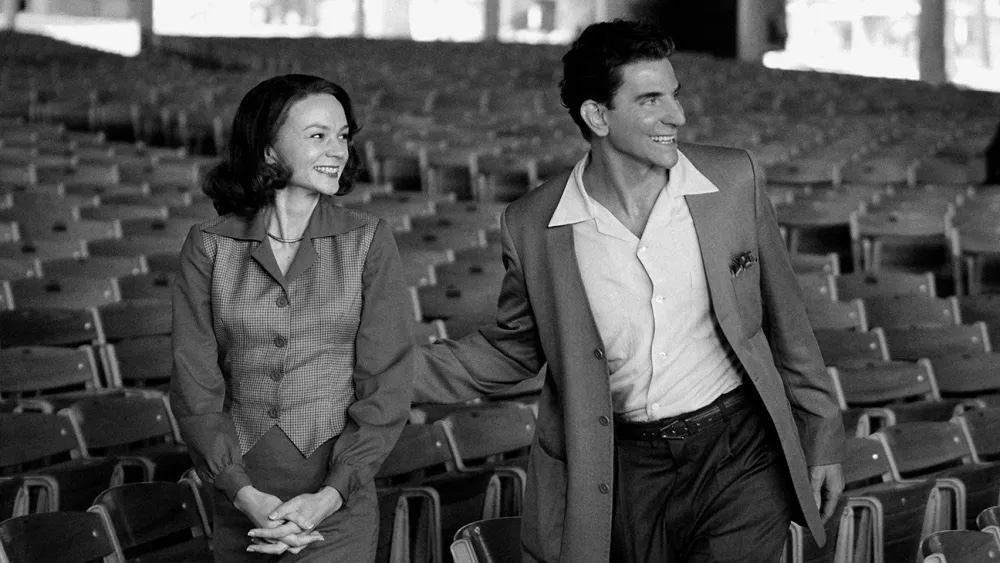
The film looks gorgeous, with the first half shot in black-and-white and the second in color. Cinematographer Matthew Libatique, who earned an Oscar nomination for shooting Cooper’s “A Star Is Born,” stages deceptive long takes that make mundane conversation scenes feel lively and lived-in, and the musical sequences oddly intense.
While the performances and musical aspects of the film are impressive, whenever Cooper chooses to focus on the family drama is when things slow down. It’s a story we’ve seen done before: a talented man who can’t be his true self because of the times he’s living in, and takes a woman around his arm to try and maintain a public perception. Whether it’s “Bohemian Rhapsody” or “The Imitation Game,” we’ve seen this tale and while it’s surely based in fact, as a film narrative device “Maestro” offers nothing new. While Cooper never shys away from showing Berstein as the gay man he was, he never goes beyond scratching the surface of the divide it caused with his marriage or relationship with his children, or the possible career fallout that count ensue from being his true self in public.
My friend described the first act of the film as a slapstick romcom, with Bernstein and Montealegre courting each other and frequenting parties. Once married, the film shifts its focus to Bernstein and his self-perceived under-accomplished career, leading up to a wonderfully shot concert. Act 3 is where things begin to get strained, turning all our attention to the relationship between Cooper and Mulligan, and much of it feels tacked on, including the final five minutes which really feel more like a “sure, let’s add this” than a required, earned, or even interesting tidbit of Bernstein’s life. Cooper co-wrote both this and “A Star Is Born” with an Oscar winner (Eric Roth before and Josh Singer here), but maybe he gets too attached to his projects to streamline things, as both films suffer from similar narratives and fatigues (though “Star” is a better film and hides its flaws more discreetly).
“Maestro” is a solid-enough music biopic with moments of greatness, but some cliché storybeats and a third act that struggles to wrap things up in a neat fashion (though not without a few effective-enough emotional scenes) hold it back from being anything special. It’s better than your typical Netflix fair, and makes another impressive directorial effort from Cooper, but here’s hoping in his third time around Cooper the director and star gets a better script from Cooper the writer.
Critics Rating: 7/10
 The Reel Deal