

2023 has given us new films from Christopher Nolan, David Fincher, Ridley Scott, and Martin Scorsese; we are so back.
“Killers of the Flower Moon” is based on the book of the same name, itself depicting the real-life Osage Indian murders in the 1920s. Martin Scorsese directs and co-wrote the screenplay with Eric Roth, as Leonardo DiCaprio, Robert De Niro, Lily Gladstone, Jesse Plemons, Tantoo Cardinal, John Lithgow, and Brendan Fraser star.
Like most people I am a big Martin Scorsese fan, and every time he has a new film coming out you best believe I will be sat (in a theater; no exceptions). His last film, 2019’s “The Irishman,” was released on Netflix after a limited theatrical run and made my year-end top 10, but has since grown to become one of my favorite films of all-time (and ranks behind only “The Departed” on my Scorsese hierarchy). “Killers of the Flower Moon” is both your typical Martin Scorsese joint and unlike anything the director has ever done in his storied career, and while it doesn’t rank atop his filmography it is the kind of meticulous and engrossing drama that rarely gets made anymore.
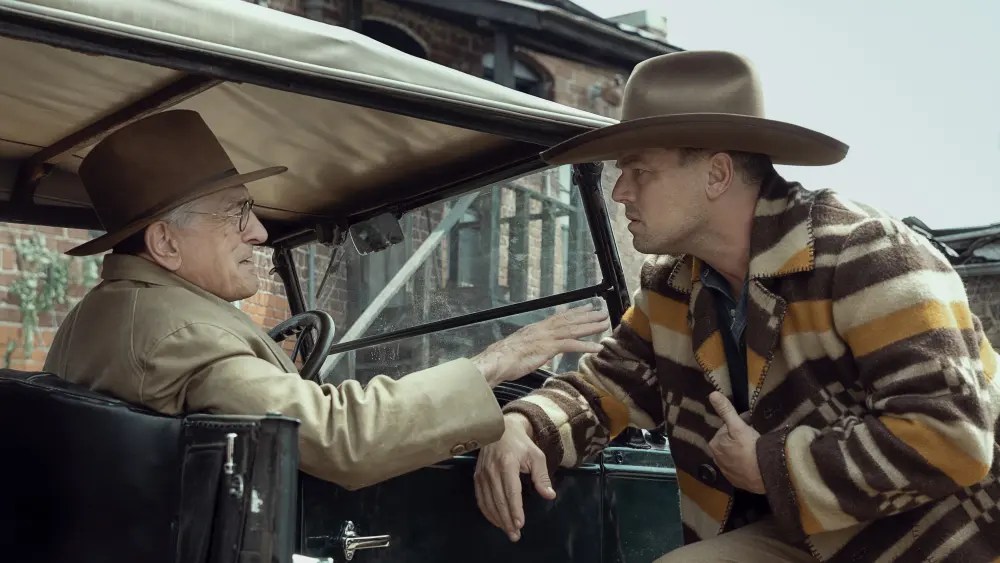
Leonardo DiCaprio and Robert De Niro are both often cited as two of the best actors of their respective generations, and Scorsese brings out the best from them like he has on so many other occasions. As Ernest Burkhart, DiCaprio is naive and often wearing a frown, though there are moments for DiCaprio to get in some of his trademark charm and quick humor (one simple, throwaway eyeroll by him made me laugh). He often tries to act like he’s in charge of a room but is quickly put in his place, by both his cunning uncle (De Niro) and calming wife (Lily Gladstone). De Niro is William King Hale, the unofficial ruler of the Osage area of Oklahoma. De Niro pulls all the strings and has all roads lead to him, as he puts on a wolf in sheep’s clothing act to the Osage people. Lily Gladstone, known in the indie film community for her work in things like “Certain Women” but not by many mainstream audiences, is silent but commanding in her own right, doing her best to bend but not break as members of her family and nation are murdered.
With a $200 million budget and shooting on-location in Oklahoma, Scorsese’s infamous attention to detail is in full effect. When we first arrive with DiCaprio to Osage County, buildings are propped up and scarce, and there are many people on the dirt streets seemingly down on their luck (this is post-World War I/early-Prohibition developing America). By the end of the film, there are sprawling paved streets full of dance studios, banks, pool halls, and other luxuries, emphasizing the wealth that the oil on the Osage people’s land brought into the area, but how they themselves benefitted less and less from it as time went on.
The screenplay, by Scorsese and Eric Roth, is probably the weakest aspect of the film, with some repetitive beats sprinkled throughout. A majority of the film is De Niro asking DiCaprio to find a guy, who knows a guy, who can do a job, and after a few times you start to want the formula to get a shake up (and it finally does once Jesse Plemons’ Bureau agents come into the fray). Gladstone is also sidelined for a large chunk of the second half, and while it serves the plot it does feel like the film starts to miss its heart (what little it had among the sea of corrupt depression). There are also a lot of characters who get introduced and name-dropped, and sometimes it’s hard to juggle who is who and what Character A wants with Character B.
So much of this feels like your typical Scorsese film, from quick cutaways to violence to the characters living in excess, but at the same time this feels like something he couldn’t have made even 15 years ago. As an Italian-American from New York City, Scorsese has no direct ties to this story or Native Americans, yet the film manages to feel personal, respectful, and almost angry all at once. As with every Scorsese film this is edited by Thelma Schoonmaker, who opts for an “Irishman” slow-burn rather than a “Wolf of Wall Street” rapid-fire style-over-substance approach. Constant collaborator Robbie Robertson returns to do the score, and it is very subtle with its drums beats and soft chants.
The film is long (that’s an understatement; it’s 206 minutes long aka 3.5 hours), and it certainly didn’t need to be that way. I was never bored, and only really felt the runtime start to add up down the final stretch, but just like “Oppenheimer” while the length is not a hinderance to the final product, you can’t help but feel it is a bit bloated by a director with an uncompromised vision (you can take that as a positive or negative). By the climax, Scorsese is forced to rapid-fire some plot points at the audience in order to wrap things up, and not all of it feels neat and some of it is a tad underwhelming.
“Killers of the Flower Moon” is “only” a good film, which may be seen as a disappointment to some given the cast and crew, not to mention the alluring true crime story on which it’s based. The film will eventually stream on Apple TV but I implore you to check it out in a theater if you can. Aside from supporting cinemas and the director, the visuals are elevated by the big screen, plus you’re pretty much forced to not look at your phone, whereas on your couch you’ll be checking texts every 15 minutes. One day we will live in a world where there isn’t a new Martin Scorsese or Robert De Niro movie to look forward to, so I’m glad I get to live in the same point in time where they’re still collaborating on ambitious projects together.
Critics Rating: 8/10
 The Reel Deal
4 thoughts on “‘Killers of the Flower Moon’ Review: A Slow, Detailed Look at American Greed”